Many engineers treat nonlinear analysis as a “black box” or avoid it altogether due to its perceived complexity. This session aims to demystify the subject by bridging the gap between fundamental concepts and practical application in SAP2000 and ETABS.
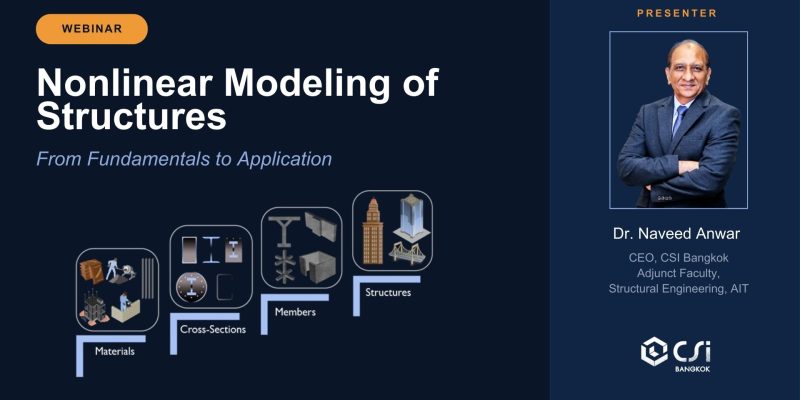
The session, titled “Nonlinear Modeling of Structures – From Fundamentals to Application,” addresses the fundamental question: when and why do we need nonlinear analysis, and how do we actually model it in practice?
We explore three types of nonlinearities that structural engineers encounter:
- Material nonlinearity – concrete cracking, steel yielding, and post-yield behavior
- Geometric nonlinearity – P-delta effects, large displacements, and buckling
- Boundary nonlinearity – bearings, isolators, gaps, friction, and contact elements
The webinar then demonstrates how to model these behaviors in SAP2000 and ETABS, covering frame hinges, fiber sections, link elements, layered shells, and P-delta settings. We focus on practical workflows that engineers can apply immediately to their projects.
What viewers will learn
- When linear analysis is sufficient versus when nonlinear modeling is truly needed
- The three types of nonlinearities and their physical significance
- How to model plastic hinges – placement strategies and hinge type selection
- When to use fiber sections versus lumped plasticity hinges
- Modeling isolators, dampers, gap elements, and friction using link elements
- P-delta analysis options – when to enable and which settings to use
- Practical demonstrations in SAP2000 and ETABS
- Common mistakes to avoid and how to verify your nonlinear model is working correctly